

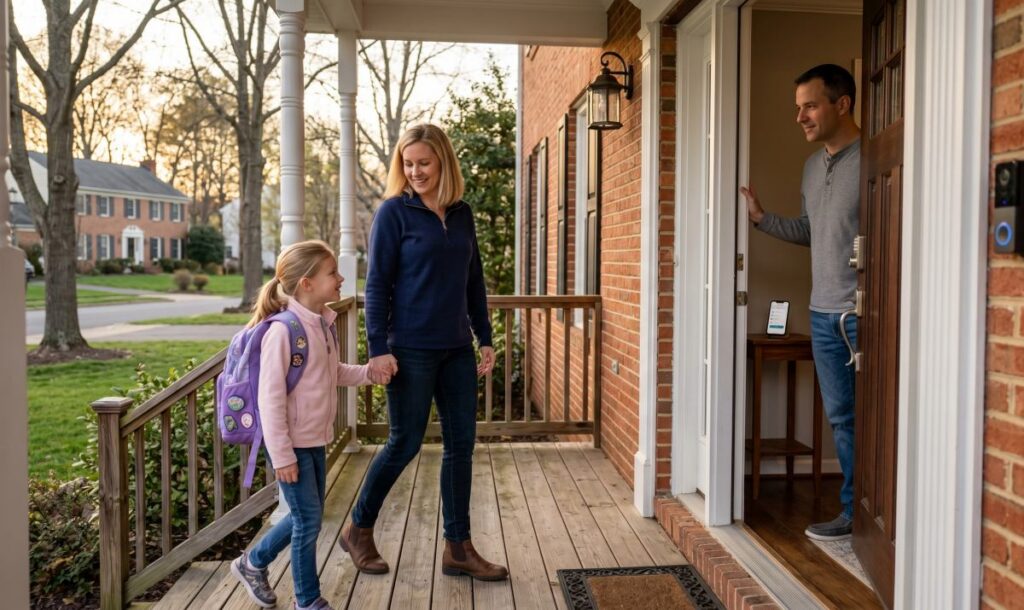
When co-parenting transitions turn toxic and every handoff becomes a battle, your devices can do more than protect your home — they can protect your peace.
Nobody warns you that the most stressful part of divorce often isn’t the courtroom — it’s the driveway. The late pickups. The name-calling at the front door in front of the kids. The he-said-she-said that follows every handoff. Modern smart home technology won’t fix a high-conflict co-parent, but it can remove you from the equation almost entirely — replacing confrontation with quiet, timestamped documentation and giving you back control of your own front door.
1. Never open the door to conflict again
A video doorbell changes the entire dynamic of a custody transition. You can see who’s there, speak through two-way audio, and record everything — without physically opening the door or putting yourself in range of verbal abuse. If the other party is 45 minutes late and arriving agitated, you know before you unlock anything. You can respond calmly through the speaker, or not respond at all, while everything is being timestamped and recorded.
The camera doesn’t react. It doesn’t get pulled into an argument. And it captures everything your attorney needs if the pattern of behavior ever needs to be proven in court.
2. Smart locks that end the “he took a key” problem
If your ex has ever had a key to your home — or still does — a smart lock is the single highest-impact upgrade you can make. Change or delete access codes from your phone in seconds, with no locksmith, no confrontation, and no waiting. You control who enters and when, and every entry is logged with an exact timestamp.
For custody handoffs, time-limited codes are a quiet but powerful tool. A code that only works during the agreed pickup window means no one can show up two hours early or linger after the window closes. The system enforces what the parenting plan says — without you having to say a word.
3. Your camera is a witness that can’t be argued with
When name-calling happens at the front door, you have a few bad options: engage (escalates), ignore (nothing changes), or document (takes time, your word vs. theirs). A camera gives you the fourth option: irrefutable, timestamped footage that requires no argument, no he-said-she-said, and no emotional labor from you after the fact.
Modern cameras use AI to detect and clip motion events automatically, storing footage securely in encrypted cloud storage. That means even if your Wi-Fi is cut, a cellular backup keeps recording. And when your attorney needs evidence of a pattern of behavior, you have a searchable, dated archive — not a journal entry.
4. Proof that you were on time — every single time
One of the most common and maddening tactics in high-conflict divorce is false accusations about custody schedule violations — claiming you were late, claiming you didn’t return the children on time, claiming you never showed up. Your security system creates an objective record of your home’s activity that neither party can edit.
Door sensors, camera clips, and access logs all generate timestamped data that can be exported in court-ready formats. When the accusation comes — and in high-conflict situations, it usually does — your response isn’t “I promise I was there.” It’s a PDF with timestamps.
5. Creating distance without disappearing
One of the most protective things you can do in a volatile co-parenting situation is remove yourself from direct interaction wherever possible. Curbside handoffs, third-party exchanges, and app-based communication all help — and your smart home system supports that same principle. When your doorbell handles the interaction, you’re present without being present. When your logs document the timeline, you don’t have to argue about it later.
This isn’t avoidance — it’s strategic de-escalation backed by technology. The goal is fewer flashpoints, better documentation, and more energy left for you and your kids.
6. A safety net that works even when you can’t call
If a situation escalates past verbal conflict, professionally monitored systems with cellular backup can dispatch emergency services even if your phone is inaccessible or your internet is cut. Wearable panic buttons with GPS tracking add a layer of portable safety for custody exchanges off-site — at schools, parking lots, or third-party locations where the home system can’t reach.
This infrastructure isn’t about expecting the worst. It’s about removing the worst-case scenario as a source of ongoing fear, so you can focus on rebuilding.
The bottom line: The most exhausting part of a high-conflict divorce isn’t any single event — it’s the constant state of readiness it requires. Smart home technology won’t change who the other person is. But it can change how much access they have to your nervous system. Every camera, every smart lock, every timestamped log is one fewer thing you have to argue about, one fewer moment you have to relive, and one more piece of evidence that speaks for itself.
Start with a video doorbell and a smart lock. Add a monitored alarm system. Enable cloud backup for all footage. Then build from there — not out of fear, but out of a very reasonable desire to never have to explain yourself again.

About Us
Eris Law Group provides client-focused representation in family and estate law. We understand that legal issues often stem from personal, emotional situations—and we’re here to bring order to the chaos.
Learn more →